
Isanti County Projected Release Dates
A projected, anticipated, or scheduled date is a current calculation, not a historical fact. The exact label matters. Minnesota materials use several terms for different legal events, including supervised release date, sentence expiration, final discharge, Parole Eligibility Date, and a Board-set projected release date. They cannot be swapped. The direct DOC record should be quoted as displayed.
An actual release date records the event after the person leaves that authority’s custody. Even then, the destination matters. Release from Isanti County Jail could mean return to the community, while transfer to MN DOC, another jail, USMS, or ICE means custody continued. Release from prison to supervised release means confinement ended but the state sentence continues in the community.
Pretrial custody is different again. A bail amount or conditional-release order can create a path out, but it is not a scheduled exit. Payment, required conditions, processing, and other holds still matter. A dismissed count does not free a person held on another case. For that reason, the Isanti roster’s charge-status phrases should never be converted into a projected release calendar.
- Projected date
- A calculation based on the present sentence data and rules.
- Supervised release
- The community portion of many Minnesota prison sentences.
- Detainer
- A request or hold from another authority that may prevent community release.
- Discharge
- The agency-recorded end of the sentence or supervision, not simply the prison-gate date.
Search Isanti County Release Dates
Choose the system from the sentence and current authority. The Isanti Sheriff roster shows current custody details, but it does not publish a release-date field. MCRO can show the court order, sentence, custody credit, and later amendments. MN DOC covers people committed to the Commissioner who remain under DOC jurisdiction, including some people released from prison and still supervised.
- Check the timestamped Isanti “In Custody” roster. Save the booking number or MNI, but do not infer a date from charge-status text.
- Search MCRO and confirm the Isanti County case. Read the sentence, credit, warrants, and amended orders.
- For a local jail term, contact Jail Master Control or use the Sheriff’s data-request process for the existing jail and court computation. Local time should not be calculated with the prison formula.
- For a state commitment, search the MN DOC public viewer by name or OID and copy every date exactly as labeled.
- If the record is missing, unclear, or outside current public-viewer scope, use DOC Data Practices or the court’s copy process.
The successful DOC search-form capture shows the official entry point for a state sentence.
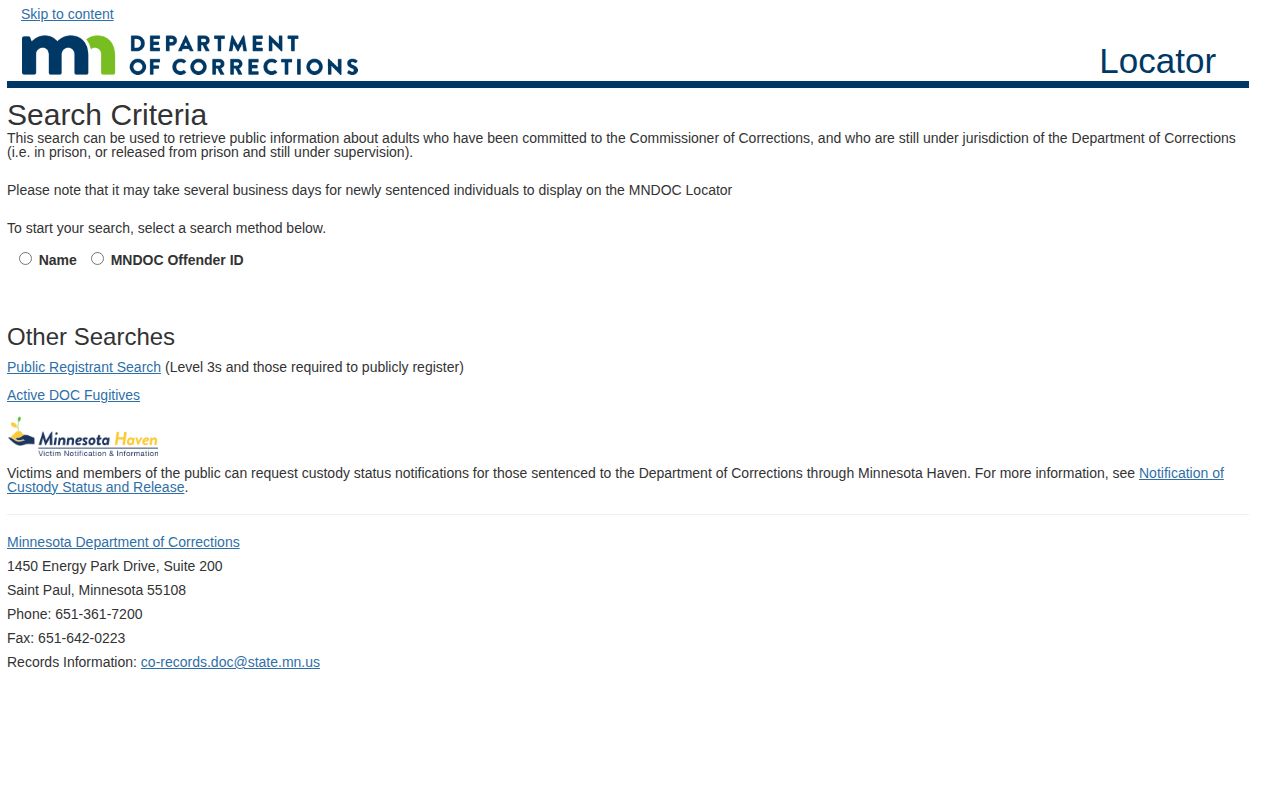
The form is relevant only when the Isanti case led to DOC jurisdiction. It is not a statewide county-jail booking archive.
When several date fields appear, record all of them with their labels and the date the search was run. Sentence expiration, supervised release, conditional release, and final discharge can mark different stages. An OID helps keep the person tied to the correct DOC result. If a fully discharged person no longer appears because the locator is limited to people still under jurisdiction, a DOC records request is more reliable than repeated name searches.
Note: A pretrial Isanti County detainee has no guaranteed date; bond, court action, and outside holds can control the exit.
Minnesota Rules for Isanti County Release Dates
Minnesota should not be described as a generic 85-percent state. Under the traditional determinate framework, many executed prison sentences have been divided into two-thirds imprisonment and one-third supervised release. For a simple illustration, a qualifying 36-month term could start with a nominal 24-month confinement portion and 12-month supervised-release portion. Jail credit, consecutive terms, offense-specific rules, discipline, earned incentives, revocation, and conditional-release terms can alter the result.
The current Minnesota Statutes chapter 244 controls the state framework. The Minnesota Rehabilitation and Reinvestment Act now provides earned incentive release credit for eligible people following an individualized rehabilitation plan. Under section 244.44, the maximum credit is 17 percent of the total executed sentence, and credit cannot reduce incarceration below half of that sentence. It changes the confinement calculation, not the court-imposed total term, and does not enlarge supervised release.
Credit can be revoked for facility-rule violations or a criminal act while confined. Life sentences, certain old indeterminate cases, and people governed by older good-time provisions are among key ineligible categories under section 244.45. This is why “good time” is too vague for an exact Isanti County release date. The offense date and governing cohort must be known.
MRRA credit does not shorten the total executed sentence imposed by the court. It reallocates eligible time from confinement within the statutory framework, and the statute says it does not enlarge the supervised-release term. Minnesota also has earned compliance credit after release, which can reduce active supervision for qualifying conduct. Neither concept should be used to estimate a jail-door date without the person-specific DOC calculation.
The official statutory capture documents Minnesota’s determinate-sentence and earned-release framework.
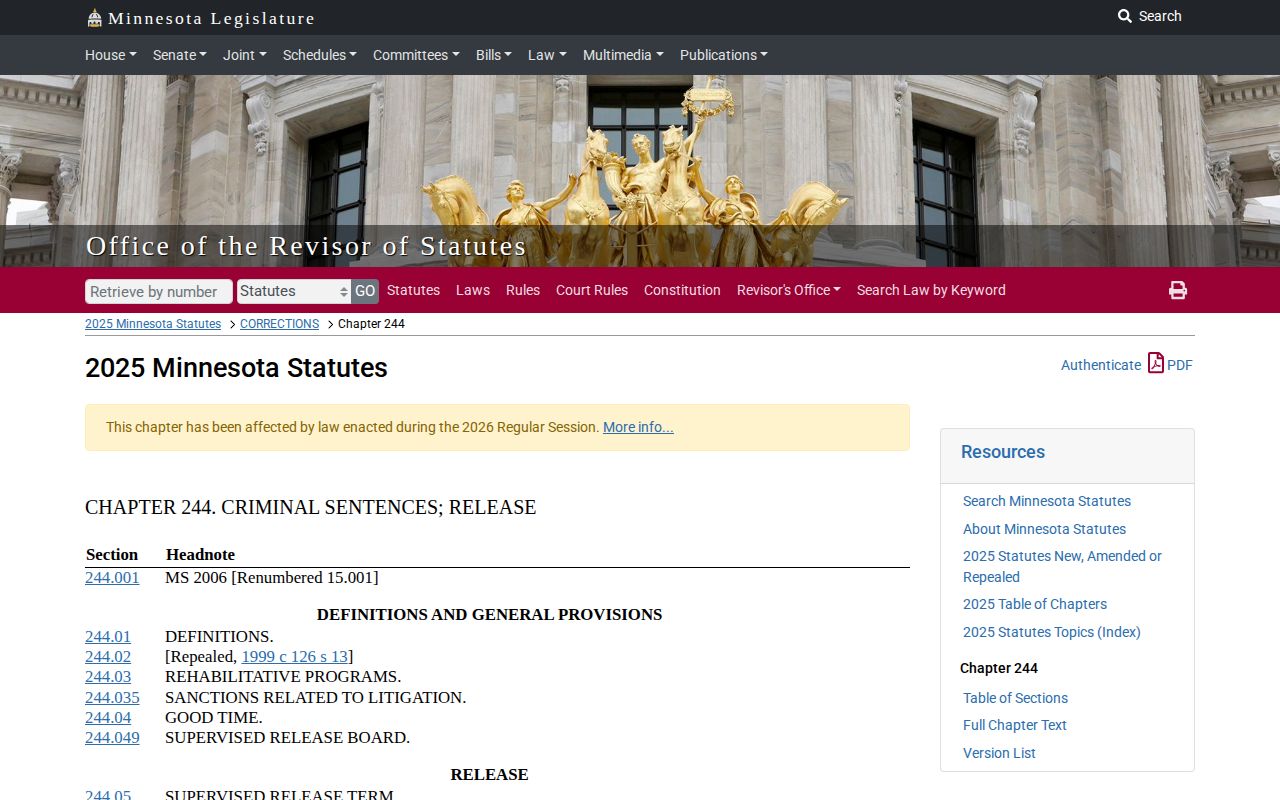
The statutes supply the framework, while DOC’s person-specific computation supplies the usable projected date.
Why Isanti County Release Dates Change
A projected date is recalculated when the legal or factual inputs change. A person-specific record may include more than one case, and a new hold can alter the destination without changing the sentence end. The date must be checked again after an amended order, discipline decision, or Board action.
| Factor | Possible effect | Best record |
|---|---|---|
| Jail credit | Changes time credited before prison or local sentence service | Sentencing order and DOC computation |
| Earned credit | May reduce confinement for an eligible state prisoner | DOC computation and current chapter 244 |
| Discipline | Can revoke earned credit or extend confinement under governing rules | DOC record |
| Amended court order | Can correct or change sentence terms | MCRO and signed order |
| Consecutive matter | Adds another term or changes sequence | Court and DOC sentence records |
| Detainer or hold | Can change community release into transfer | Isanti release/transfer transaction |
| Board decision | May grant, deny, defer, or rescind a date in covered cases | Board minutes and DOC record |
A passed date is not proof that the person left custody. Check the resulting status, receiving authority, and actual transaction. The Sheriff release record is decisive for the local jail exit; DOC controls a state prison event.
An administrative correction can move a date in either direction without a new court sentence. DOC may receive revised jail-credit information, discover a data entry issue, or apply a governing rule differently after review. A new warrant or detainer may leave the computed prison date intact but change what happens at the gate. That distinction is why the final record needs both the date and destination.
Isanti County Release Dates on Weekends
Minnesota Statutes section 244.05, subdivision 1a contains an offense-date-dependent weekend and holiday rule for state prison. For covered crimes committed before August 1, 1992, a date falling on Friday, Saturday, Sunday, or a holiday moves to the prior qualifying day. For crimes committed on or after that date, it moves to the first qualifying day after it.
This rule belongs to the state-prison calculation. It should not be applied to every sentence served at Isanti County Jail. Local jail time can involve sentence start, custody credit, staggered service, court conditions, and holds. Isanti Community Corrections forms include a Staggered Sentence Notice, which confirms that some local custody can be served in segments. Ask the jail or court for the exact local computation.
A staggered sentence may require a person to report for separate custody blocks. Leaving after one block does not necessarily mean the sentence is complete. The Isanti court order and local jail transaction should show the segment and later reporting duty. This is another reason a single roster disappearance cannot answer “when will they be released” for the full sentence.
Note: The offense date determines which state weekend rule applies; the later case-filing or release-search date does not.
Minnesota Board and Isanti County Release Dates
The Minnesota Supervised Release Board is not a general parole calendar for all determinate sentences. Since July 1, 2024, its discretionary release and final-discharge authority covers defined classes such as eligible life sentences, certain old indeterminate sentences, and covered people who were under 18 at the offense. For Board cases, DOC uses Parole Eligibility Date, or PED, for the statutory minimum.
An initial readiness review may occur about three years before the minimum, but it cannot authorize release before eligibility. The Board may set a projected release date or continue the review with directives. Published materials include meeting notices, schedules, agendas, recordings, and approved minutes. A permanent name-searchable outcomes database was not found, and older records may require a data request.
The Board can grant, deny, continue, or rescind a date within its authority. A prerelease-condition violation can lead to rescission before the person leaves prison. The Board overview and approved minutes should be read with the individual DOC record.
Section 244.05 provides for Board decisions by majority vote and a grant or denial with an explanation no later than 30 days after the review hearing. A denial can allow a later request on the statutory cycle. Meeting schedules alone do not show the outcome. Current agendas and approved minutes are the public result channel, while older materials may fall beyond the short online window and require a data request.
The section 244.05 capture provides the statutory context for release calculation and Board eligibility.
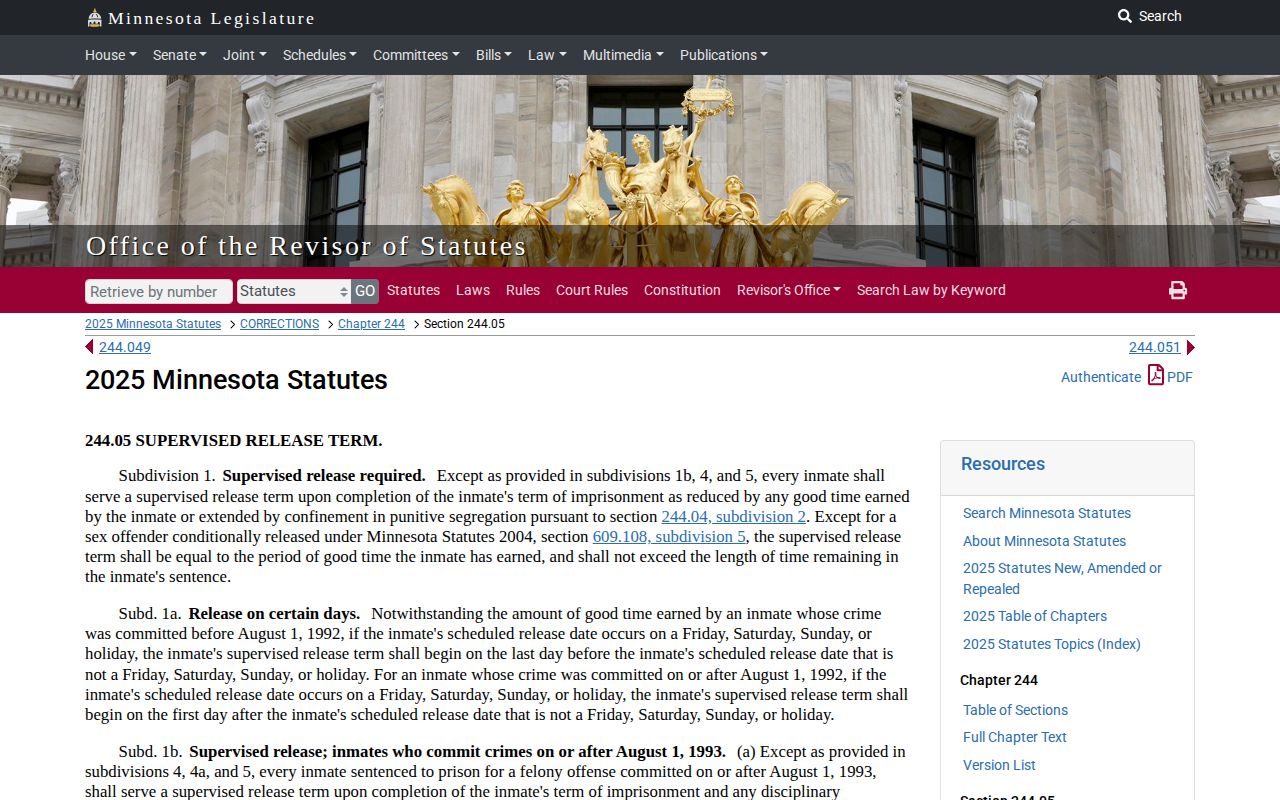
Board terms should be used only when the person falls within its limited statutory jurisdiction.
Confirm Isanti County Release Dates
For Isanti County Jail, check the current roster, use VINE for an event, and request the Sheriff’s release or transfer transaction. Minnesota Statutes section 13.82 identifies public adult arrest data that include the date, time, and legal basis for release, plus transfer details when applicable. The record can resolve whether the person returned to the community or entered another authority’s custody.
For DOC, reopen the public viewer after the projected date and read the exact status. A released-but-supervised result means the prison portion ended while DOC jurisdiction continues. When a live result is unclear or a fully discharged record is absent, request the offender record from DOC Records Management.
DOC Records Management lists phone 651-361-7330, fax 612-473-5006, and CO-Records.DOC@state.mn.us. Its Data Practices process includes a government-data form and, where needed, an authorization form. A person challenging inaccurate information in their own record can use the separate accuracy or completeness process. That is different from asking the Sheriff to correct an Isanti jail transaction.
A pending county-jail event can also be tracked through the Isanti County VINE inmate check. VINE is an alert, not documentary proof. Keep the agency release record and court order as the final evidence of date and legal basis.